
Just passing through, but on his own terms
A naturalist talks you through a tusker sighting
(The engine is off. The naturalist leans slightly forward, speaking quietly)
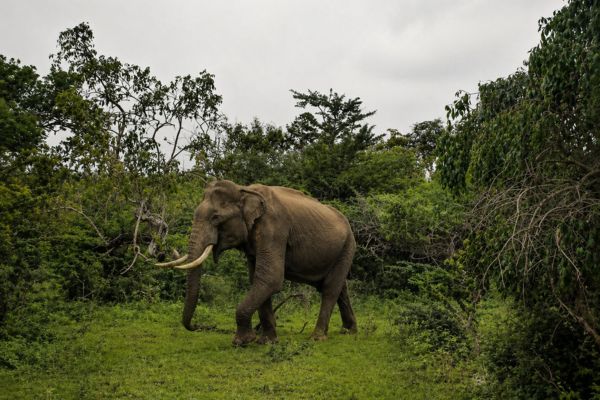
Just keep your eyes on him for a moment. Look at those magnificent tusks as he moves. You can see how they sit forward, almost part of his stride. They are not just for show you know, he uses them for everything… digging, testing the ground, pushing through vegetation and, of course, duelling with other bulls! If you look closely, you can see the wear on them. You’ll also notice that he is not feeding. He is not stopping to pull at grass or reach for anything. He’s just walking… steady, no hesitation, no wasted movement. Even though it may seem like he’s not doing much, he is actually not wandering aimlessly. Bulls like him spend a lot of time alone, and what you are seeing now is him moving between places he already has in his head… where to go, when to go, what to avoid… places with plenty of water, good shade, favourite feeding spots and so on.
Fun Facts
Now, even though he looks like he is ambling along, he is actually covering a fair bit of ground. Bulls can walk several kilometres in a day without ever looking like they are in a hurry. Notice how little effort he wastes? He is not crashing through the bush. He is picking his path, stepping around thicker growth, keeping things easy. If you are wondering why he is alone, that is pretty typical. Unlike the herds, which are social and usually led by females, adult males tend to drift on their own and only come together for short periods. Now, do you see how his head and his trunk are positioned? No tension there. That means he is nice and relaxed. If he was unsure or alert to something, you would see it straight away. Fortunately for us, we’ve encountered him during a calm period in his life. Because when reproductive hormones go into overdrive, Bulls go into a condition known as Musth. During that time, they become intense and unpredictable and it wouldn’t be safe to get this close. So moments like this, where he is just moving through the landscape, they might not seem dramatic, but this is actually one of the best ways to understand how a tusker lives out here.
Story of the Photo
Mahoora Naturalist Vimansha captured this beautiful moment inside Yala National Park, as a mature tusker moved slowly through the scrub, completely at ease and on his own path. While guests at Mahoora Tented Safari Camps often encounter elephants in the park and occasionally near the camp itself, thanks to its close proximity to the park boundaries, sightings of tuskers are far less common. Which is why watching a bull like this, unbothered and moving with such quiet purpose, is always a very special moment.
Mahoora tented safari camps Sri Lanka.

Important Links
Resort Locations
Mahoora Tented Safari Camps,
20/63,
Fairfield Garden,
Colombo 08,
Sri Lanka
(10800)